


Cloud and SaaS Exposure: Secure Your Shadow Cloud
Zero Connectors. Zero Permissions. Zero Blind Spots.
Your internal Cloud Security Posture Management (CSPM) tools are excellent "Quartermasters." They can catalog and monitor the cloud assets they are authorized to access. But what about the assets they don't know about? The forgotten development environments, the rogue marketing storage, and the unfederated SaaS applications?
ThreatNG acts as your external "Scout." We operate entirely from the outside in, using purely external, unauthenticated discovery to identify shadow cloud assets and rogue data repositories that your internal tools cannot see.
No API keys. No internal agents. Just the adversary’s view of your multi-cloud perimeter.
Stop guessing what attackers can see. Uncover your true cloud exposure today.

Break the "Connector Trap": Purely External, Agentless Mastery
Traditional security tools put you into a "Connector Trap," requiring disparate API keys, agents, and permissions for every cloud provider and application you believe you own. This situation leaves you unaware of the 65% of your estate that is unsanctioned or forgotten.ThreatNG’s one-of-a-kind approach is entirely connectorless, performing purely external, unauthenticated discovery of your entire Cloud and SaaS footprint, requiring only a domain name. This non-impactful methodology ensures zero friction for your business units and zero performance drag on your infrastructure, as it never touches your production systems or user devices. Fully tunable to your organization's specific risk appetite via DarcRadar, this approach identifies "unknown unknowns" exactly as an adversary would, providing the irrefutable evidence of due diligence you need to restore authority across your borderless digital frontier.
Our Core Cloud Capabilities
Zero-Connector Multi-Cloud Discovery

Stop assuming your cloud footprint is limited to what your IT department officially sanctioned. ThreatNG’s agentless discovery engine actively hunts for misconfigured and exposed storage across the entire cloud ecosystem. We explicitly discover and map :
Amazon Web Services (AWS): Open S3 Buckets and exposed infrastructure.
Microsoft Azure: Unsecured Azure Data Lakes and Storage Blobs.
Google Cloud Platform (GCP): Open Google Cloud Storage buckets.
SaaSqwatch: Illuminating Shadow SaaS

Traditional SaaS security relies on checking internal Identity Providers (such as Okta) or on monitoring corporate network logs. But what happens when employees bypass the IdP and use personal email addresses or credit cards? ThreatNG’s "SaaSqwatch" capability discovers unsanctioned, unfederated Shadow SaaS from the outside in. We identify exposed instances across all of the following types of SaaS, closing a massive blind spot in third-party supply chain risk:
Business Intelligence, Collaboration, Communication, Content Management, CRM, Customer Service, Data Analytics, Endpoint Management, ERP, HR, IAM, Incident Management, ITSM, Project Management, Video Conferencing, Work OS
The DarChain Blueprint: Context over Asset Hoarding
Pure External Attack Surface Management (EASM) tools often provide a "pile of bricks" in your driveway, which consists of a list of 5,000 unknown cloud assets that your SOC team must manually investigate. This creates immense alert fatigue.
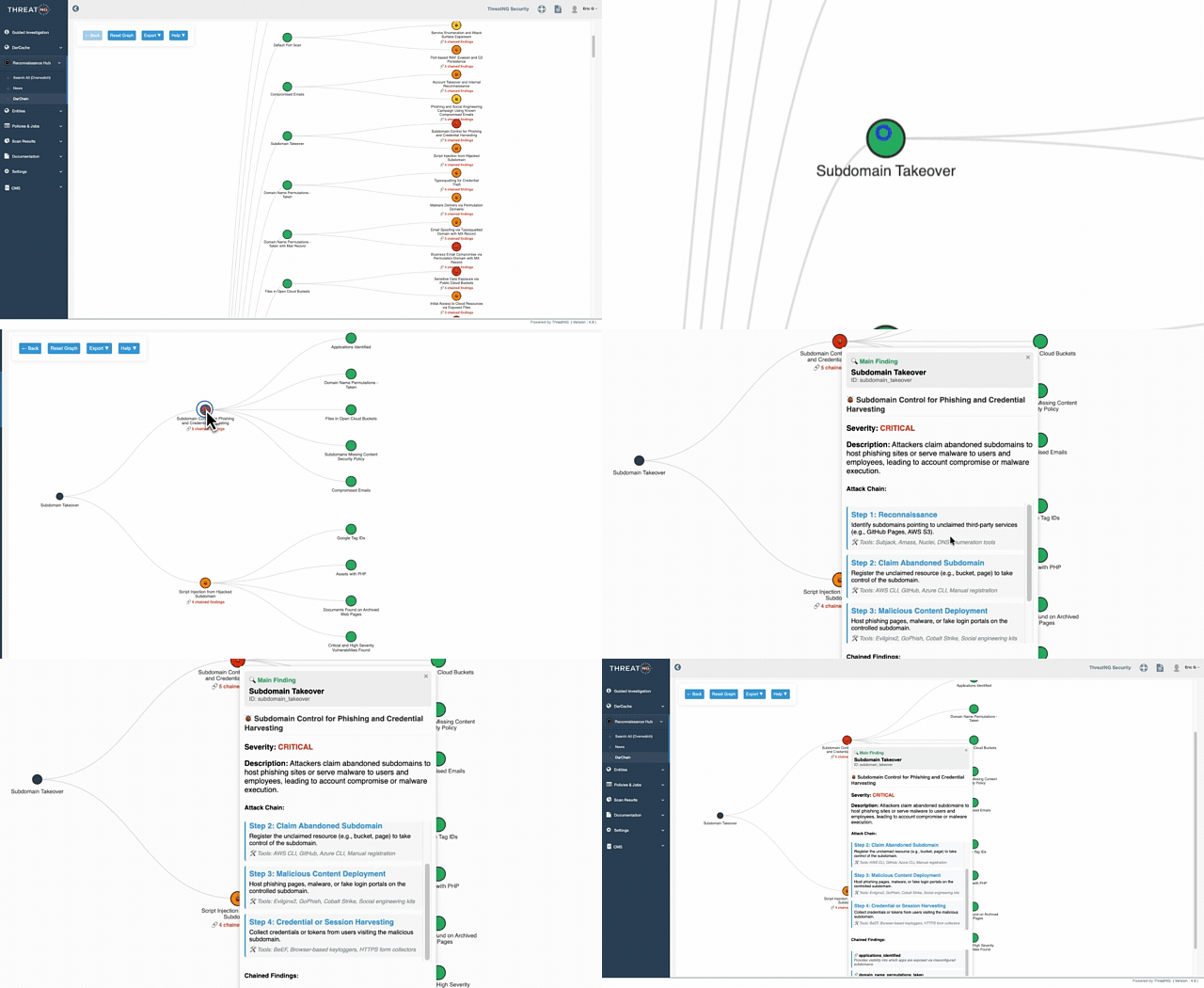
ThreatNG delivers the "Blueprint." Our DarChain (Digital Attack Risk Contextual Hyper-Analysis Insights Narrative) engine connects findings to consequences. We don't just alert you to an exposed Azure Data Lake; we map the exact exploit path, showing how a missing file in that specific bucket enables credential extraction and directly links to a Data Exfiltration or Ransomware Event. We give your team a prioritized narrative, not a homework assignment.
Engineering Certainty Across the Sprawl: A Unified Approach to Risk

Legal-Grade Attribution for Cloud Assets
One of the highest hidden costs for a Security Operations Center is investigating open cloud buckets that belong to third parties or companies with similar names. ThreatNG’s proprietary Context Engine correlates technical findings with decisive legal, financial, and operational data to achieve Irrefutable Attribution. When we flag an exposed GCP bucket or AWS S3 instance, we provide the definitive proof that it belongs to your enterprise, allowing you to prioritize remediation with absolute certainty.
Operational Mastery: Eliminating "Connector Fatigue" and the Hidden Tax on the SOC
Your analysts are drowning in a sea of fragmented tools, each requiring its own integration and maintenance. ThreatNG ends this operational drain with a quick Veracity Check that covers both Cloud and SaaS simultaneously. Because our approach is entirely agentless and connectorless, there are no API keys to manage and no rollout delays. We map technical exposures across your entire stack directly to Attack Choke Points via DarChain modeling. By using a single solution to find a single truth, your team shifts from the chaos of manual verification to the "silence of certainty," reclaiming thousands of hours lost to the "Hidden Tax on the SOC".
Absolute Visibility: Closing the Reconnaissance Gap in the Shadow Ecosystem
Adversaries do not distinguish between a misconfigured cloud instance and an unsanctioned SaaS application; they simply see an entry point. ThreatNG applies the same technical rigor, monitoring the global "digital exhaust" to identify every sanctioned and unsanctioned footprint associated with your brand. By using a uniform, unauthenticated approach, we uncover Shadow AI and SaaSquatting domains before they can be weaponized against you. You regain the advantage by closing the Reconnaissance Gap across your entire ecosystem at once, enabling your business to move fast because you finally have eyes on everything.
Built for the Risk Accountable Leader
Enterprise CISOs: Demanding a unified, defensible "Outside-In" view to eliminate personal legal liability.
SOC Directors: Seeking to eliminate "alert fatigue" by replacing fragmented internal tools with a single source of verified truth.
Heads of IT & Procurement: Empowered to reclaim budget by identifying redundant spend across both cloud infrastructure and SaaS subscriptions.

ThreatNG Cloud & SaaS Investigation: Frequently Asked Questions
Core Discovery and Visibility
-
By monitoring "digital exhaust" through purely external, unauthenticated discovery. Unlike traditional tools, ThreatNG identifies internet-facing footprints—such as DNS records, CNAMEs, and HTTP headers—to inventory sanctioned and unsanctioned applications exactly as an adversary would see them, requiring zero internal access or prior knowledge of the assets.
-
CASBs require agents and connectors to detect sanctioned apps; outside-in discovery identifies sanctioned, unsanctioned, and malicious apps without requiring internal access. While a Cloud Access Security Broker (CASB) primarily manages internal authenticated traffic, it is inherently "SaaSquatting ignorant" and blind to forgotten or unmanaged assets that live outside the corporate perimeter.
-
ThreatNG provides a 3-hour Veracity Check. Because the solution is agentless and connectorless, it bypasses the typical months-long rollout of internal agents. By entering a domain and organization name, you receive a prioritized state-of-affairs inventory of your cloud exposure and SaaS sprawl within minutes.
Emerging AI and Non-Human Identity Risks
-
Because they rely on human-centered IAM systems and lack visibility into the machine-speed, non-human identities (NHIs) used by autonomous AI. AI agents function as goal-driven identities that can operate across cloud platforms, SaaS tools, and local machines. These "actors" often bypass traditional Multi-Factor Authentication (MFA) and governance frameworks designed for predictable human users.
-
Employees often feed proprietary code, sensitive business data, or financial reports into unvetted AI tools to enhance productivity. Without visibility, this data exposes the AI vendor's Large Language Model (LLM) training sets, effectively placing your organization's intellectual property in the public domain or exposing it to model-based vulnerabilities such as prompt injection.
Personal Liability and Executive Defensibility
-
Yes, under new SEC reporting rules and legal precedents (e.g., SolarWinds), failure to monitor known or "discoverable" assets can be seen as gross negligence. Regulators now piercing the "corporate veil" target security executives for misleading investors or failing to manage known deficiencies. If an open bucket is discoverable via external reconnaissance, the CISO may face personal fines, employment bans, or criminal charges for failing to perform due diligence.
-
This is the industry-wide gap: tools generate thousands of technical findings (e.g., CVEs or open ports) without the business context needed to prioritize them. ThreatNG resolves this by providing Legal-Grade Attribution, correlating technical risks with decisive legal and financial context to prove who owns an asset and why it matters, giving the C-Suite the confidence to act with certainty.
Operational Efficiency and Brand Protection
-
By performing continuous passive reconnaissance for brand permutations and typosquats staged on the global web. ThreatNG monitors the internet for registered domains and Web3 variations containing targeted keywords like "login" or "pay," allowing you to dismantle malicious infrastructure before a phishing or Business Email Compromise (BEC) campaign is launched.
-
This "tax" is the operational burden on security teams, who spend hours performing manual asset verification and WHOIS lookups for every alert. ThreatNG eliminates this drain by automating external discovery and mapping technical exposures to Attack Choke Points—specific nodes where one remediation can disrupt an entire exploit chain.
-
DarChain transforms dry technical logs into real-world adversarial narratives. It maps the precise path an attacker would take—from an abandoned subdomain to an open S3 bucket—showing the Board exactly how a breach could occur. By focusing on high-fidelity, multi-stage exploit chains rather than static hygiene scores, you demonstrate proactive resilience and business enablement.

Cloud and SaaS Exposure

Domain Intelligence

Social Media

Sensitive Code Exposure

Search Engine Exploitation

Online Sharing Exposure

Sentiment and Financials

Archived Web Pages

Dark Web

Technology Stack